Towards the Perfect Visual Novel Conversion
Jul 16, 2026
The perfect visual novel conversion would be one that maximizes the entertainment, engagement, and informational value of a book without degrading, distracting, encumbering, spoiling, misrepresenting, contradicting, or disrespecting its original intended reading experience.
Somewhere in the Visual Novel Library of Babel, there exist those ideal forms. But until we have a magic AI wand that can extract them, we have to work towards them ourselves.
So, to that end, how close is the Public Domain Pulp project to the ideal?
The Many Failures
Public Domain Pulp's visual novels are abysmally far from perfect.
Just to non-comprehensively list out some of the current VNs' many shortcomings:
- The VNs' UI and control and configurability are incomplete and unpolished.
- The basic features standard to other visual novels (i.e., sounds, animations, interactivity, so on and so on) are mostly either fully unimplemented or, at best, underimplemented.
- The images themselves are riddled with problems: inaccuracies, inconsistencies, and general ugliness abound throughout the visuals.
- The VNs demonstrate just a general lack of editing polish in interactions and flow between text and visuals.
…With many many more problems that could be listed here. (Enough to warrant a whole post!)
However:
Despite the horrific disaster that most of the site's current batch of VNs are, the trend is one of improvement.
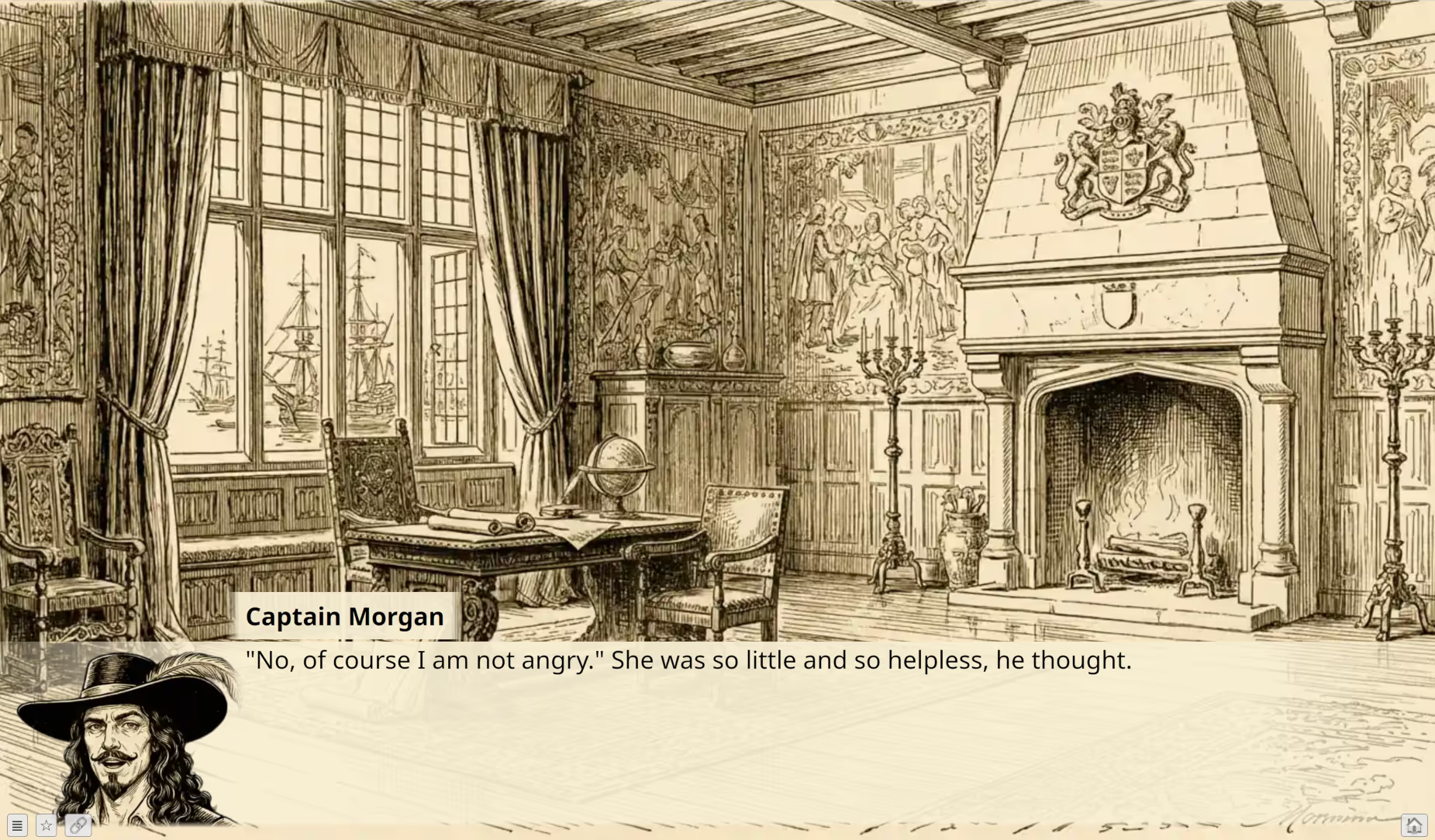
Compare the site's first VN in its initial UI appearance:
…To the the most recent (at time of writing) published VN (the site's 12th):
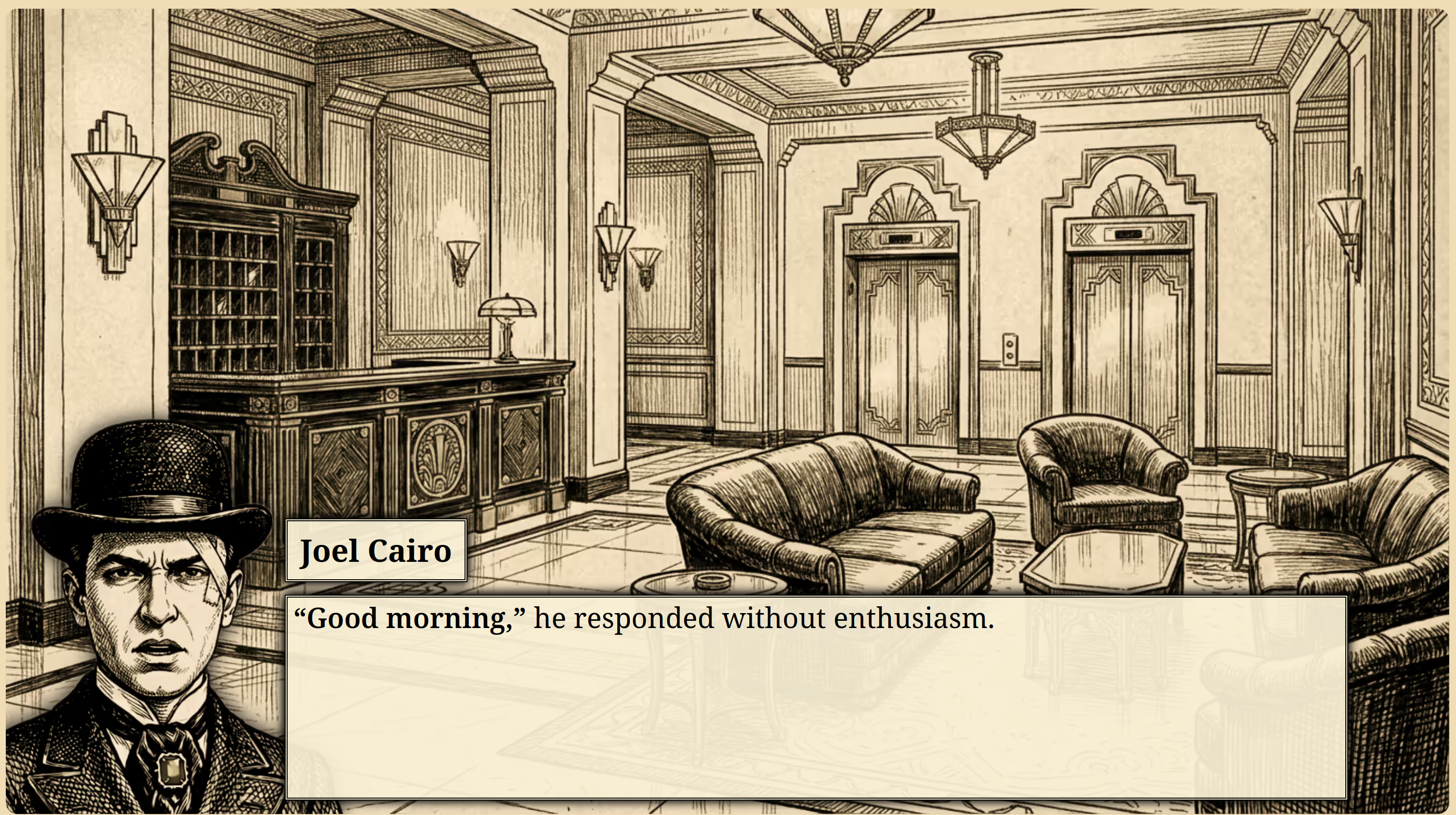
There are some positive developments:
- The backgrounds, previously universally awful to look at, are becoming no longer universally so. (Cleaner!)
- The sprites, previously wildly inconsistent in both their visual quality and in their adherence to the text, are becoming less wildly so.
- The character expressions, previously often way off from any actual emotion implied by the text, are less often way off.
- The text flow, previously horrendously muddling-up dialogue and non-dialogue, is now less muddled.
…With many at least several more improvements that could be listed here.
The point being: the site may be overall bad, but it's becoming less bad over time. (A principle you could make a whole annoying website out of.
Towards the Ideal: Practical Progress
It's one thing to have gone from terrible to somewhat less terrible. It's another to continue that trend towards eventually being good. That requires having actionable room for improvement.
Luckily, such opportunities exist:
Animations
The latest in-progress VN (The Picture of Dorian Gray) is working on introducing some new filter effects around custom fade transitions, and also shaking-type hitting animations and blood-like reddening animations and lightning-type flashing animations.
The plan is to continue adding more custom effects like these to add more visually dynamic "action" to the visual novels. (Doing this in a way that doesn't destroy the quick readability of the text.)
The UI
There's a variety of enhancements in the (eventual) works for the UI, such as:
- Adding more slider input configuration options, especially around textbox sizing.
- Improving the textbox, frame narrative, and other rectangle-shaped UI elements to all be more visually diverse and thematically decorated, perhaps being used to further visually distinguish different active speakers.
- Improving the visual contrast between speakers and the backgrounds behind them, perhaps leveraging more filter options for speaker sprites.
- Improving the UI that exists around the visual novel window itself, including sprucing up the buttons, sliders, table of contents, and other elements.
- General bug fixing, like in addressing the current performance degradation of having too many filters on-screen at once.
…With many other related tasks in the site's TODO list.
Images
The quality (and consistency) of the site's images has improved significantly since the site's first VN, but even the most recent one is still not without its visual issues.
At this point, the problem has become less of figuring out the right image generation pipeline (the process there has been mostly ironed out) and more about continuing to hone better editing and curation skills for what makes images are good enough to make the final cut, with the trend here showing likely further improvement.
Visual Novel Remakes
The earlier in the site the publish date, the worse the visual novels get. Eventually, those early VNs — especially the first six — will need to be re-edited, so as to fix the disrespect against Twain and Fitzgerald and Stevenson. And Hemingway and Steinbeck and Buchan too, I guess. But they kind of deserve it.
Those re-edits will probably need to be total ones, replacing all the images and touching up significant portions of the metadata to be good enough for (then-)current standards. (This could involve just fully scrubbing the old crappy versions of the VNs off the site, though it may be more fun to leave two versions up — the new and the original — for history's sake.)
Visual Novel Continued Editing
At the same time, the good less bad visual novels may not need total re-edits, but they certainly could all benefit from targeted fixups and enhancements. This should naturally happen over time, pulling from each VNs' outstanding TODO list, as time permits. (And to plug the open source nature of the VNs: anybody could help make these improvements!)
Denser Editorializing
The "Editor's Notes" are a main secondary goal of the site, in pursuit of the larger goal of maximizing the VNs' books' entertainment value.
In general, it seems surprising that nothing like MST3K/Rifftrax-style riffing exists for books, considering how high the potential comedic value-add is. (372 Pages exists, but is a different type of format.)
In any case, the visual novel format is particularly well-suited for riffing, due to how the editor's notes can be placed on-screen alongside the text, rather than buried in footnotes or perhaps highlights, as would be required in a regular text-only book.
And more editor's notes can and will continue to be added into each of the site's VNs — as many as can be packed in without becoming tiresome — to extract all the engagement value riffing allows for.
And More…
There are many more scattered TODOs on the list for the site.
But rather than continue listing out all the miscellaneous near-future practical changes, let's consider:
Towards the Ideal: The Perfect Future
What would the perfect idealized visual novel conversion look like?
What would the experience be if we could pull in all of the features of all existing VNs into all existing books?
Animations (Again)
Small-scale animation enhancements were touched on before in the practical section, but there's theoretical potential for so much more:
- Images themselves and the transitions between them could feature custom animations, along with custom effects.
- The text itself could be animated as it crawls out onto the screen, paired with text appearance sound effects. (Though perhaps only optionally, as any such effect would necessarily slow down the reading experience.)
- The UI itself could be animated, moving about dynamically as part of keeping up with the text, character, background, and context changes.
Music
Visual novels generally have some form of soundtrack that plays in the background.
So far, the site doesn't have this, because retrofitting music and music transitions to fit existing text is challenging. But challenging doesn't mean impossible — it would just require time and attention to detail.
Plus: there's tons of potential for using classical music from the public domain. (Or: just generating the soundtracks. Whichever works better in practice.)
Speakers
Visual novels generally also have spoken audio for their bits of dialogue.
Again, this is a harder problem in the context of a book-converted visual novel, where dialogue and non-dialogue tend to be less cleanly separated. Relaxing the requirement to have different speakers for different characters, audiobook-style audio could certainly be used fine (public domain recordings even exist!), but there would still be problem of timing the slide breaks and ensuring those breaks don't distractingly chop up the audio.
Again (again), it's not an impossible task, just one that would demand time and effort. (And again, perhaps a practical solution would leverage custom AI-generated audio for the special problems a VN conversion would run into.)
Themes
The site currently only has the one theme — the literary-/paper-style cross-hatching-type theme. It's a theme that works well for literary conversions (and one that makes color consistency easier), but there's no reason the site need be limited:
More engaging visual themes could be created: some perhaps more stylized, some perhaps more colorful, and some perhaps more editorialized. And some perhaps more alluring.
Again again again, there'd be work involved in supporting custom themes, perhaps require splitting out the VNs' metadata into multiple git branches, so as to support custom tag attribution per theme. But with the time and effort (and perhaps the willingness to slightly disrespect the original texts), such visual options could be added.
Interactivity?
Going way out there:
Wouldn't the ideal book VN conversion have choices? Wouldn't the ideally VN conversion have gameplay?
It's hard to imagine how such features could ever be implemented in a non-gimmicky way, what with the site's strict (self-imposed) requirement of not modifying the original text ever seemingly precluding the possibility of choices or consequences ever existing. Even so, if we entertain the idea:
Bringing up 372 Pages again, that podcast features a variety of book-based challenges, such as the iconic "Real-or-Fanfic" guessing game, the over/under word-usage count game, and the sonic challenge. Perhaps these ever work visual novel minigame features!
Probably not, but perhaps some clever variation on the idea with the right implementation could find some new way to create true interactive entertainment value out of an originally static reading experience.
Perhaps.
What's the Point of it All?
This blog began with a claim: "The perfect visual novel conversion would be one that maximizes the entertainment, engagement, and informational value of a book without degrading, distracting, encumbering, spoiling, misrepresenting, contradicting, or disrespecting its original intended reading experience."
But why have visual novel conversions of books at all? If it's so hard to retrofit visual novel features to fit books, then why not just keep books as books and VNs as VNs, letting each play to their own strengths, separately?
Books
Books are great, and it's great that an essentially endless supply of great books already exists in the public domain. Books are even sometimes quite entertaining as well. But only sometimes.
Books, even the great ones, are not as engaging as other forms of media. They can't be as engaging as other forms of media. (The postmodernists have tried and failed.)
And as the volume and addictiveness of alternative media options has expanded, books have declined — a decline of an inevitable nature, borne out of opportunity cost.
The great prose of the world is contained within books, but it's their destiny to be read by fewer and fewer. (And even among those who still do read them, to do so for fewer and fewer titles.)
Visual Novels
Conversely, visual novels are trashfire garbage.
The prose involved in VNs is invariably awful, and the characters are invariably immature and awful, and the plots invariably stupid and awful, and everything about their whole existence is invariably awful.
And yet: visual novels are entertaining and engaging, and continue to be bought and read (due to being entertaining and engaging). Whether or not it's fair, there's something hard-wired in that format that makes us more invested — simply seeing a face has the power to make us more invested.
Public Domain Pulp
The point of the Public Domain Pulp is to try to synthesize these two types of media together — to steal the engagement value back away from stupider media and inject it into back into the slower but gooder medium.
The implementation of Public Domain Pulp is to try to do this in the best way possible:
- Keeping the original prose of converted books unchanged, unabridged with no simplifications.
- Keeping the licensing of the converted books public domain, free forever to read and improve upon.
- Extracting all that can be extracted from the medium of visual novels and stealing its power for more worthy texts, doing this in as well-edited a manner as is practical.
- Injecting editorializing on top of the visual novels, acting as an optional additional layer from which to engage from. (Much in the same way that a reaction video acts as junk food form of media, yet still somehow manages to scratch a consumption itch.)
And finally: balancing the fundamental tradeoff between attempting to reach an ideal form for any given visual novel with the site-wide ideal goal of converting as many public domain books as possible.
All this; all to hopefully elevate books towards being competitively entertaining again, for the sake of literature.
…
…
…
Or: perhaps those are all post-hoc self-justifying rationalizations around a real goal of hedonistic entertainment-maxing.
But, if that's what it takes to get good prose to be read: eh…